Saturday, September 20, 2014

Any successor to the Oracle needs Promethean vision

(Published in the South China Morning Post on 29 April 2007)

It lacks the hype that surrounds the release of a new Harry Potter novel, but as a free source of investment insight, Berkshire Hathaway's annual letter to shareholders is in a league of its own. This year's letter — issued last month and written, as always, by chairman Warren Buffett — featured a number of topics that were widely seized upon, such as the Oracle of Omaha's continued assault on the pay of hedge-fund managers and senior company executives.

While these are important issues, the real insights into Mr Buffett's investment approach are found elsewhere. The trick is to parse the 24 pages properly to glean the gems of wisdom. So much has been written about the Oracle, and yet he remains an enigma. On one level, it's how the letter is peppered with the sort of sharp wit we do not normally associate with the investing world, and certainly not with bespectacled 76-year-olds in pinstripes.

Let's face it: investing is right up there with undertaking when it comes to guffaws, maybe because both are associated with loss. Surely, equating an acquisition target with "a gorgeous blonde with a body that would cause, a bishop to go through a stained glass window" would be entirely inappropriate for a fund that just underperformed its benchmark for the second year running.

What really confounds, however, is that although Mr Buffett is invariably described as a value investor, his letter hardly makes reference to intrinsic value, the holy grail of value investing.

The VI school teaches that with detailed analysis of company accounts plus shrewd forecasting and conservative discount rates, one can calculate precisely the fair — or intrinsic — worth of a stock. When this amount is higher than the current share price, so the mantra goes, it's a great investment, the theory being that over time the stock market valuation will rise to meet the fair value.

Perhaps what has made the label so sticky is that Mr Buffett studied at Columbia University under Benjamin Graham, the father of value investing, and that there won't be an authorised biography of the Berkshire chairman until next year.

I suspect that Mr Buffett has never been in a hurry to dispel that label for the same reason that he remains quietly ecstatic that the efficient market hypothesis still features on most investment course syllabuses. Regarding that flawed theory, he notes in this year's letter: "If you are in the shipping business, it's helpful to have all your potential competitors be taught that the Earth is flat."

I am not suggesting that a young Mr Buffett took no notice of what Mr Graham, imparted so many years ago about the need to find stocks that are reasonably priced. I'm saying only that it is a given that the Oracle buys neither "overvalued" companies nor ones that he thinks are not going to grow.

What comes across more than anything in Mr Buffett's letter to shareholders is that he is an investor in managerial talent. He claims, modestly, that he takes the easy route, "sitting back and working through great managers". Terms such as "true managerial magicians", "extraordinarily talented managers" and "remarkable entrepreneur" give a very good indication of what really matters to the Oracle.

The underlying message is that unless there has been a recent speculative surge in a stock or a company's business is in decline, most firms with great management will make good long-term investments.

It is instructive that the word "manager" and its derivations are used 39 times in Berkshire's letter. That compares with zero in the US$43 billion Fidelity Magellan Fund's 2006 report, aside from the title Management's Discussion of Fund Performance and a reference to Harry Lange as the "portfolio manager". Sure, Magellan Fund's report was only 300 words long, but this in itself is revealing.

So what constitutes great management in Mr Buffett's eyes?

Energy, independent thinking and dedication, of course, but it is the less conventional that is of real interest. Mr Buffett, in the letter, relates the story of a meeting with National Fire & Marine owner Jack Ringwalt in the mid-1960s at which he was due to close the sale of his company to Berkshire Hathaway. Mr Ringwalt arrived late, explaining that he had been driving around looking for a parking meter with some unexpired time. That, for Mr Buffett, "was a magical moment for me. I knew then that Jack was going to be my kind of manager".

Another issue of interest is Mr Buffett's references to risk. In the past century, a good understanding of risk has been very elusive, mainly because uncertainty, to use its other name, is just that — uncertain.

The pioneers of modern portfolio theory chose to define risk as the volatility of stock returns, which they erroneously assumed varied according to the normal distribution curve. In fact, as the 1987 crash and the collapse of Long Term Capital Management attest, extreme events in the real world cannot be described by simple averages and standard deviations.

When writing about Berkshire's search for a successor, Mr Buffett notes: "Over time, markets will do extraordinary, even bizarre, things. A single, big mistake could wipe out a long string of successes. We therefore need someone genetically programmed to recognize and avoid serious risks, including those never encountered before [Mr Buffett's italics]. Certain perils that lurk in investment strategies cannot be spotted by use of the models commonly employed today by financial institutions."

If this describes you, Mr Buffett invites you to call him, day or night.


A run of the mill attitude is no way to invest

(Published in the South China Morning Post in July 2009)

I'll be upfront. I don't like exchange-traded funds (ETFs) or, more precisely, the way they are being used.

ETFs appeal particularly to those who do not have the time, inclination or tools to sniff out a good active manager. Granted, they have worked well. Over time, stock market indices, which ETFs were designed to track, have outperformed around two-thirds of active managers. Invest a little money in an ETF every month and over 20 years, say, you will almost certainly do better than the average fund.

Institutional investors have long grasped this. For some years a "core/satellite" approach to asset allocation has been de rigueur. The bulk of a given portfolio goes to a passive index tracker, while smaller, but potentially higher alpha-generating allocations go to specialist managers investing in less efficient areas such as global emerging markets.

Originally, index mutual funds performed the passive work. They have got better as computer power has improved. And they have always been cheap, though fees and tracking error can cause them to underperform the index they mimic. But while index mutual funds can only be traded once a day, ETFs are listed and thus provide continual liquidity. Moreover, they increasingly offer access to more esoteric opportunities.

A few years ago, ETFs were good for investing in commodities or single strategies like oil or gold. They had the great benefit of opening up these once-illiquid and seemingly non-correlated investment areas to mainstream investors. Today, such a focus seems run of the mill. There are ETFs that go short; there are leveraged funds; and there are many that don't invest in any physical asset but instead, invest via swaps and other derivatives. All this invention may be evidence of dynamism. But it may also have unintended consequences.

The majority of ETFs originate from big investment banks which alone have the capability to make these products work. Yet in focusing on narrow market opportunities, many of the newer ETFs are not that cheap (once you take into account trading costs and market spreads); and they often replicate customised indices, making them difficult to compare.

Far from being a tool to capture the beta of a well-traded strategy, ETFs are increasingly put forward as vehicles to generate alpha themselves. And because they are listed stocks, the temptation is to trade them.

As US firm Dalbar notes in its annual survey of investor behaviour, mutual fund investors have underperformed markets by several percentage points each year by getting their timing wrong. Time and again we see the biggest inflows at the top of the market and outflows at the trough. There is no reason to think investors timing their ETF trades in gold or oil have done any better.

To my mind, the corporate equivalent of an index fund would be a company that did everything, and in a mediocre, average way. I doubt such a company would last long. Success is about being different not average.

Consider what the bulk of passive strategies do. They track indices based on weights in securities with no distinction between good and bad. By that count, a Dow Tracker would have held General Motors and Citibank until this May (when they were ejected).

Why there's no market turmoil on Vulcan

(Published in the South China Morning Post on 26 August 2007)

It is hard to think of something to say about the recent upheaval in world financial markets that hasn't already been said either this time round or following previous crashes.

History is prone to repeat itself, especially in the world of finance. This is because markets are the ultimate expression of human nature on a mass scale, and human nature, with its predilections for occasional irrational behaviour, remains con-
Stant.

Take humans out of markets and they would be a dull affair. Were CNBC broadcasted on the planet Vulcan, for example, correspondent Spock of Logical Securities would report: "Once again, all stocks rose today by 0.03 per cent. This is the expected rate of return and is fixed for all stocks as our perfect foresight means there is no risk. "Like yesterday, and the day before that, today's earnings results were all in line with expectations, not surprising really, given that we know exactly what the future will bring and that we all behave totally rationally."

It is our innate irrationality that drives markets. Much has been written about the role of computer algorithm traders, known as quants, in the recent selloff. Surely if computers, devoid of emotion, play more of a role in dishing out buy and sell instructions, markets should become more rational, right?

Wrong. Computer models are, of course, written by humans, and if they're all the same, which they are, herding becomes even more in-
tense.

In fact, in many ways the sharp decline in volatility and the attendant steady rise in markets in recent years were synonymous with the hypothetical Vulcan stock market. The problem was that everyone woke up one day and remembered that we lived on a planet called Earth where it was humans who approve home mortgages to borrowers with no income, humans who securitised and rated them and humans who bought them. Oh yes, and it was humans who programmed computers.

Goldman Sachs chief executive David Viniar, in a call to investors in its funds that had been damaged by their use of computer modelling; said: "We are seeing 25 standard deviation events, several days in a row." To put this into English, he was suggesting that what had happened in markets was something that should only be expected to happen every several trillion years.

Since this in itself is absurd, because it did happen; what Mr Viniar was admitting was that the models were flawed.

In this case, the computer models are not human enough. They do not take account of the impact on financial markets of their buy and sell orders, also known as the feedback effect. Self-awareness is a uniquely human trait and one that is impossible to build into computer programs given our current programming skills and computer capabilities.

There is talk of artificial intelligence and non-linear neural networks that will address this issue, but for now it remains just talk. And anyway, most of the time computer models work just fine. It's just that their very existence will mean that we'll occasionally have these increasingly-hard-to-understand ruptures in the financial markets.

It wasn't that long ago that it was the bank managers who extended loans and they knew where to find you. But times have changed and nowadays things are more complex. While this complexity on the whole improves efficiency in the financial industry, it also means that the occasional bout of panic gets amplified.

On the radio last week, a reporter asked what has become a common question — whether the rating agencies should shoulder some blame for not warning us of the imminent collapse of stock markets.

This is another absurd proposition, as it suggests that we have the capability to panic in an orderly fashion. What were the rating agencies to do? Say that everything will be fine and dandy as long as we don't rush for the exit en masse?

The fact is that the warnings were there for anyone who wanted to listen. But by then it was too late — our lemming-like mentality had taken over.

The behaviour of the ratings agencies is merely symptomatic of the problem, the root of which lies in the increased complexity of financial instruments, which in turn lies in the increased demand for risk management tools, which itself lies in our negative emotional response to financial loss, which ultimately lies in human nature.

Get the gist?

This imperfection in our psychology has been exacerbated by our desire to describe the world in a mechanistic, Newtonian way, rather than qualitatively. Thanks to Harry Markowitz et al, we have been wrongly persuaded that volatility is bad since it is synonymous with risk. His idea that investors get rewarded for assuming more risk was a sound one but his model required a quantitative measure of risk, for which he chose the standard deviation — the volatility — of historic returns.

The fact is, the uncertainty associated with market crashes cannot be defined by the bell curve as his the sudden, unpredictable lurches in volatility like we had in the past month that presents true risk not the normal sweeping ups and downs.


Rule 1: Know your investment target

(Published in the South China Morning Post on 24 June 2007)

Watching recent footage on television of punters gathered around computer screens at Shanghai brokerage outlets, poring over charts of stocks in their portfolios, made me wonder whether they have any idea what they actually own?

I recall visiting one of these outlets in the early nineties and witnessing an impromptu lecture on Elliot wave theory on market cycles — so I was told — given by a gentleman who would have made a rickshaw driver look well dressed.

Not much, it seems, has changed.

As with all stock-market bubbles, irrationality reigns supreme, and investors lose sight of what they are actually acquiring.

Did a buyer on Friday of 9,400 Kweichow Moutai A shares at 121 yuan, for example, consider that he bought one hundred thousandth of the assets and liabilities of the company?

Does he know that if he drank the annual production capacity he effectively owns, he would need to guzzle 100kg, or 2,000 bottles, of Moutai — not to mention the company's other products?

And, perhaps most importantly, does he know he paid 173 yuan for one yuan of dividends, representing a paltry yield of 0.5 per cent?

I doubt it. If he is like so many other investors, yield is how much his shares are going to rise in the next month. As far as he is concerned, what he owns is that colourful line on the computer screen, and the rewards he expects are in the same ballpark as those won at a casino, the stock exchange's not-so-distant cousin.

You might think this column is about stock-market bubbles. It is not. The above example simply illustrates how easy it is to disregard what one actually owns when dabbling in shares, a luxury you may think you can afford while a bubble lasts.

But bubbles always go pop.

As billionaire investor Warren Buffett famously remarked, "Only when the tide goes out do you discover who's been swimming naked".

The point is that it is always a good idea to know what you're buying, even — or particularly— if others don't. Most companies are sufficiently capable of presenting their best side (take the case of Enron). It is therefore more a question of you working out who is wearing Speedos.

The best way to quickly work out what lies beneath the surface is to read a company's latest annual report, which should be available on its website. (If it isn't, that is a good reason to avoid the stock anyway— either they don't want you to see it or they're dumb, both negatives.)

You do not need a CFA or a holiday weekend to work it out either. Here is a 12-point guide to tearing apart an annual report in 10 minutes.

No doubt many will find this all a bit basic, but then rarely is sticking to the basics in any activity a bad idea.

Note that companies that do not pass the following test are not necessarily bad investments. There will be plenty of interesting situations that slip through the net.

What this checklist tries to do is identify companies that will make very steady, long-term investments, for sensible investors who have a reasonable amount of time to dedicate to the pursuit of stock picking.

As in astronomy, it is all about having an efficient way to decide where to point your telescope so that you give yourself the best chance of finding stars.

·               By looking at the annual report for one or two minutes are you able to understand what the company does? There are, no doubt, companies that are very difficult to understand but whose shares perform well. However, you may not be able to sleep comfortably at night not knowing how their success is being achieved.

·               Do you think that demand for the company's products will rise in a relatively steady fashion over the long term? This will discount cyclical stars such as commodity and semiconductor companies that may take you on a wild ride.

·               Does the company have a reasonably dominant position in its industry? On the whole, dominance is a good thing as all sorts of good things come with it, such as economies of scale and high barriers to entry.

·               Do you think that brand value matters to the company? Brand value can add several percentage points to a company's profit margin and is a significant competitive advantage. It is therefore something that companies treasure and, in the absence of incompetence, can last forever.

·               If the company has a mission statement or a set of core values at or near the front of the annual report, do you feel that a lot of thought and care went into their composition? Companies who stick inane, generic statements at the front of their annual reports are not making much effort to sell themselves to you, and likely in other ways as well.

·               Does the annual report contain a table summarising the company's five or 10-year financial track record, and does it show a relatively stable history? This point is partly related to the fact that companies that include clear, long-term historic data have made a conscious effort to provide useful information, and partly to check that the company has not had a volatile past.

·               In the notes to the accounts, does the list of subsidiaries cover more than two pages? The choice of two pages is fairly arbitrary, particularly since font size can vary and disclosure requirements can vary from country to country. The point is that, as with question one, it is more difficult to feel comfortable investing in complex corporate structures. At best they are difficult to understand. At worst, complex structures can be indicative of something more sinister.

·               Are there any worrying qualifications in the auditor's report? As a rule of thumb, any qualification is worrying.

·               Compared with other annual reports, do you get the impression that the company looks after its employees? Companies are nothing without their employees. A sign that a firm appreciates this fact is always heartening.

·               Does the company have a worth- while profit margin? Profit margins vary from industry to industry, so there is no specific target rate. I therefore tend to use return on equity as a better measure of profitability and look for companies whose returns have been above 15 per cent annually for the past five years.

·               Does the company have a strong balance sheet? As a general rule, stick to firms with net debt to equity ratios below 30 per cent. The legendary stock investor Philip Fisher said he never invested in highly geared companies, even if they were well run.
  
·               If the company's investment programme has required external finance, has this been sourced mostly with equity? Intensive fixed asset investment programmes can present exciting opportunities, particularly since they tend to depress profits in the short term, resulting in share price weakness. But financing them with debt is generally a bad idea. In the cash flow statement, add together investments in subsidiaries, fixed assets and other non-current assets, and subtract "cash flow from operations". A red flag should go up if this number is less than double the amount under "increase in debt" (one or more items in the "cash flow from financing activities" section of cash flow statement). Again, this yardstick is somewhat arbitrary and there will almost certainly be specific issues that complicate the picture, but carrying out this calculation should be instructive.

Even though an annual report is a backward-looking document, it is probably the most efficient way to identify companies that are well placed to do well in the future. To quote the "Oracle of Omaha" again, "If a business does well, the stock eventually follows".


Paying the price of overconfidence

(Published in the South China Morning Post on 7 January 2007)

Poor decision-making is largely to blame for the dreadful returns realised by US mutual fund investors. That is the conclusion of the Dalbar study, a yearly analysis of fund flows and fund performance first published in 1994.

From 1984 to 2002, US equity mutual fund investors earned an average annual return of 2.6 per cent compared with 12.2 per cent for the S&P 500 Index.

Dalbar estimated that 2.9 percentage points of the difference were due to fund underperformance and operating costs while a staggering 6.7 percentage points were due to poor decision-making by investors, specifically poor timing and fund selection.

In fact, John Bogle, who founded Vanguard Group and the first index fund, testified to the US Congress in 2003 that the returns were even worse on a dollar-weighted basis. Accounting for the huge sums that investors poured into "hot" technology funds in 1999 and 2000 at the top of the market, Mr Bogle estimated that returns were significantly in the red over the period.

Behavioural finance experts explain this poor decision-making in terms of our natural tendency towards overconfidence and bias. Researchers say people consistently overrate their knowledge and skill.

In their paper in the Sloan Management Review in 1992, Edward Russo and Paul Schoemaker presented the results of their tests in which securities analysts and fund managers were posed a series of questions and, in addition to being asked for a precise answer, were also asked for a range in which they were 90 per cent sure the actual answer resided. On average, the analysts chose ranges wide enough to accommodate the correct answer only 64 per cent of the time. Fund managers were even less successful at 50 per cent. Groups that very accurately calibrated their confidence levels included weather forecasters, bookmakers and professional bridge players.

So how does this overconfidence among fund investors manifest itself when it comes to. decisions to buy and sell mutual funds? Overconfidence impedes performance because investors consider outcome ranges that are too narrow. For example, if markets have fallen, investors significantly underestimate the likelihood of them bouncing. And the belief that a "hot" fund will continue to be so often becomes dogmatic.

Paradoxically, overconfidence prevents you from being aware of your overconfidence. I hear myself saying, "No! You are wrong! I am certainly not overconfident," in response to being so accused. We need to be shown the evidence.

Here goes. In a room of 30 people, what is the probability that two people share the same birthday? One in 100? One in 200? It can't be more than 10 per cent, can it? Well, it's actually 71 per cent. Surprised?

An example of erroneous perception is provided by "the Monty Hall problem", named for the host of US TV's Let's Make A Deal: you are on a game show where the objective is to win a car. The host shows you three doors and says there is a car behind one of them and a goat behind each of the other two. He asks you to pick a door. You pick a door but it is not opened. Then the host, who knows what is behind each door, opens one of the two you didn't pick to reveal a goat. He then offers you the chance to change your pick to the other unopened door. What should you do?

The problem was sent to Parade magazine's Ask Marilyn column in 1990. Author Marilyn vos Savant answered that you should always switch doors as this doubled your chances of winning from one in three to two in three. There was an avalanche of letters to the magazine, some from writers with a PhD in mathematics, saying she was wrong, and accusing her of lowering education standards. (Incidentally, Mrs vos Savant held the Guinness world record for the world's highest IQ from 1986 until 1989, when the ranking was abolished.)

You may think, as I did at first, that Mrs vos Savant is wrong and that switching doors wouldn't alter the odds. Surely, if there are two doors left, the chances are 50-50 either way, right? Wrong. I spent an entire evening trying to persuade one of my smarter friends that by switching doors you increase your odds. Not only did he disagree, but he was convinced he was right. I resorted to tearing up three pieces of paper, marking one with a cross, and repeatedly playing the game until he saw empirically the switching strategy did in fact double the chances of winning.

Once you are able to recognize the overconfidence that causes errors in your perception, you will be in a better position to make more sensible investment decisions.

The problem is that overconfidence otherwise helps us in our daily battle for survival. But while the need to appear competent and confident might help, for example, in securing a job promotion, it hinders sound decision-making in stock market investing.

Whatever your assessment of your own confidence, you would do well to remember that few people think they are below-average drivers. Fewer still think they are below-average lovers. To the real Schumachers and Casanovas out there, I salute you, as I suspect you can get by without really needing to be any good at investing.

For the rest of you, I suggest you keep asking yourself why your answer could be wrong and why other answers could be right.


Theories can't count cost of risk

(Published in the South China Morning Post on 19 November 2006)

Risk. It's a word thrown around so frequently in the investment world there's risk-adjusted, systematic risk, specific risk, and we all know that beta, alpha, cost of equity and the Sharpe Ratio have something to do with it. But what is it actually?

In the 1950s, the early pioneers of modern portfolio theory (MPT), such as Harry Markowitz, Merton Miller and William Sharpe, asked themselves this question when they came up with the simple hypothesis that investors get rewarded (with higher returns) for taking on greater risk. For this idea to go any further, though, they had to have a way of quantifiably measuring risk.

They came up with a simple, if controversial, solution: risk (of any asset) can be measured by the standard deviation of historic returns (of that asset). In other words, the more volatile the returns from a given asset the more risky it is.

From this simple assumption - and several others, such as markets being efficient, that one measure of risk applies to all investors, that there are no transaction costs - grew MPT and its flagship, the risk-gauging capital asset pricing model, to this day the cornerstones of the financial economics curriculum in schools, investment associations and financial institutions.

For their work in the field of understanding how asset prices behave, Dr Markowitz, Dr Miller and Dr Sharpe shared the 1990 Nobel Prize in economics. Building upon MPT and work by Robert C. Merton and others, Fisher Black and Myron Scholes published a paper in 1973 introducing the options pricing model that bears their name. Its basic assumption is equities move randomly; that is, their returns are distributed according to the normal bell curve, which charts the frequency of random walk outcomes.

The model assumes that volatility does not change much, and prices options as a function of the historic volatility of the underlying asset.

This worked well in normal market conditions, where changes in volatility were gradual, but if volatility abruptly increased it would break down. Dr Merton and Dr Scholes - members of the team that in 1994 established the ill-fated Long-Term Capital Management (LTCM) hedge fund received the Nobel Prize in 1997 for this and other work.

Best-selling financial author Roger Lowenstein, in When Genius Failed, his excellent book on the US$4 billion collapse of LTCM, said: "Every investment bank, every trading floor on Wall Street, was staffed by young, intelligent PhDs, who had studied under Dr Merton, Dr Scholes or their disciples. The same firms that spent tens of millions of dollars per year on expensive research analysts - i.e. stock pickers - staffed their trading desks with finance majors who put capital at risk on the assumption the market was efficient, meaning that stock prices were ever correct and therefore that stock picking was a fraud."

It is now known that a significant portion of the instructions on Black Monday, October 19, 1987, to sell large blocks of shares came from black box, or automated, trading programs into which the Black-Scholes model had been built. The initial fall in markets caused by Germany's unexpected interest rate increase - and the associated rise in volatility - triggered a self-fulfilling wave of computer-driven panic. The programs were spitting out sell instructions assuming the increased volatility was highly unusual - which in the real world it was not - further increasing volatility and causing more sell instructions.

In the aftermath of the 1987 crash, Harvard economics professor Lawrence Summers, later a United States treasury secretary, remarked to The Wall Street Journal: "The efficient market hypothesis is the most remarkable error in the history of economic theory."

And all of this from the simple assumption that volatility equaled risk. What went wrong?

The dictionary definition of risk is the possibility of loss.

Applied to financial markets, risk should mean the probability that an investment - whether a portfolio or an individual asset - will perform worse than expected.

But whose expectation? After all, expectation is a subjective quantity. In investing, expectation belongs to the investor. Everyone is entitled to have a different expectation for their investments. It is ludicrous to suggest that Warren Buffett and a day trader would see eye to eye on a particular stock, especially if they were both holding it at the same time. One would want the stock to grow at a steady pace over many years, while the other would be happy with a half-point bump before lunch. Yet MPT posits they should see eye to eye, defining risk as the objective historic volatility of a given stock. Furthermore, asset price returns are not normally distributed. In the real world, the supposedly well-distributed curve has a lump at each end, known as the fat tail (see chart). The tails describe extreme events - such as Russia's 1998 debt default that brutally exposed LTCM's weakness – which are not as rare as the theory says they should be.

The ultimate irony about short-lived LTCM - the penultimate one being its name - is that two of its partners, Dr Merton and Dr Scholes, proponents of the Efficient Market Theory, built a model to take advantage of arbitrage opportunities created by market inefficiencies.

These are not new observations, but the speed at which old-established theories are debunked is agonisingly slow. The likes of Mr Buffett who I suspect does not calculate his risks by looking at historic stock price movements - must hope the pace of change remains slow and that the Nobel committee continues to bestow its awards on academics sitting in their ivory towers, far removed from the messy world of nuts, bolts and corporate profits.

So what is the point of all this? My advice is to throw away the textbooks and accept that, at least for most investors, there is no point in worrying about volatility. On the contrary, you should learn to welcome it, as your shares can't go up without it. The only sure fact is that over periods of 10 years or more, markets tend to go up, and that most of this appreciation will be due to rising corporate profits.

Ultimately, the only reliable model of the real world is the world itself. As University of Chicago economist Eugene Fama – often thought of as the father of Efficient Market Theory - famously remarked, life always has a fat tail.

Think before you invest - overconfidence is a killer

(Published in the South China Morning Post on 15 October 2006)

In a November 2005 report, James Montier, the maverick global equities strategist for investment bank Dresdner Kleinwort Wasserstein in London, identified seven deadly sins of fund management. For that matter, they apply just as well to any investor.

They are: poor forecasting; being fooled by the illusion of knowledge; being mesmerised by company management; believing you can out-smart everyone else; short-time horizons and over-trading; believing everything you read; and group think.

In varying proportions, he argued, they were all responsible for the poor decision-making that leads to unhappy returns. The performance of funds, after all, or any investment portfolio, is the result of a series of buy and sell decisions. The fact that around 70 per cent of actively traded funds does worse than their benchmark indices suggests that the average fund manager may actually be hardwired to make poor decisions.

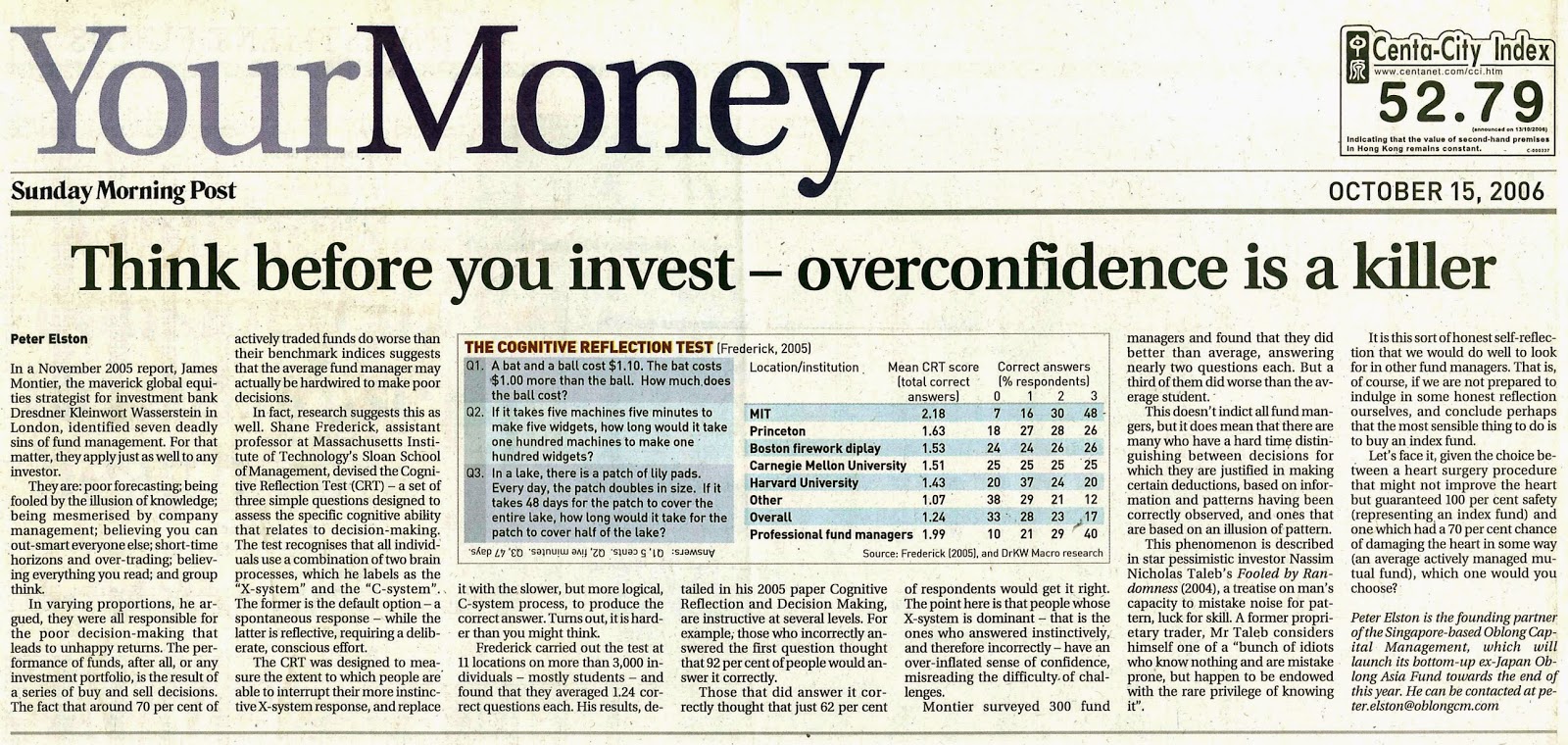
In fact, research suggests this as well. Shane Frederick, assistant professor at Massachusetts Institute of Technology's Sloan School of Management, devised the Cognitive Reflection Test (CRT) — a set of three simple questions designed to assess the specific cognitive ability that relates to decision-making. The test recognises that all individuals use a combination of two brain processes, which he labels as the "X-system" and the "C-system". The former is the default option — a spontaneous response — while the latter is reflective, requiring a deliberate, conscious effort.

The CRT was designed to measure the extent to which people are able to interrupt their more instinctive X-system response, and replace it with the slower, but more logical, C-system process, to produce the correct answer. Turns out, it is harder than you might think (see the original at the bottom of this post for the test questions and answers).

Frederick carried out the test at 11 locations on more than 3,000 individuals — mostly students — and found that they averaged 1.24 correct questions each. His results, detailed in his 2005 paper Cognitive Reflection and Decision Making, are instructive at several levels. For example; those who incorrectly answered the first question thought that 92 per cent of people would answer it correctly.

Those that did answer it correctly thought that just 62 per cent of respondents would get it right. The point here is that people whose X-system is dominant — that is the ones who answered instinctively, and therefore incorrectly — have an over-inflated sense of confidence, misreading the difficulty. of challenges.

Montier surveyed 300 fund managers and found that they did better than average, answering nearly two questions each. But a third of them did worse than the average student.

This doesn't indict all fund mangers, but it does mean that there are many who have a hard time distinguishing between decisions for which they are justified in making certain deductions, based on information and patterns having been correctly observed, and ones that are based on an illusion of pattern.

This phenomenon is described in star pessimistic investor Nassirn Nicholas Taleb's Fooled by Randomness (2004), a treatise on man's capacity to mistake noise for pattern, luck for skill. A former proprietary trader, Mr Taleb considers himself one of a "bunch of idiots who know nothing and are mistake prone, but happen to be endowed with the rare privilege of knowing it".

It is this sort of honest self-reflection that we would do well to look for in other fund managers. That is, of course, if we are not prepared to indulge in some honest reflection ourselves, and conclude perhaps that the most sensible thing to do is to buy an index fund.

Let's face it, given the choice between a heart surgery procedure that might not improve the heart but guaranteed 100 per cent safety (representing an index fund) and one which had a 70 per cent chance of damaging the heart in some way (an average actively managed mutual fund), which one would you choose?